

Beyond the Prompt: From Studio Artist to Art Director
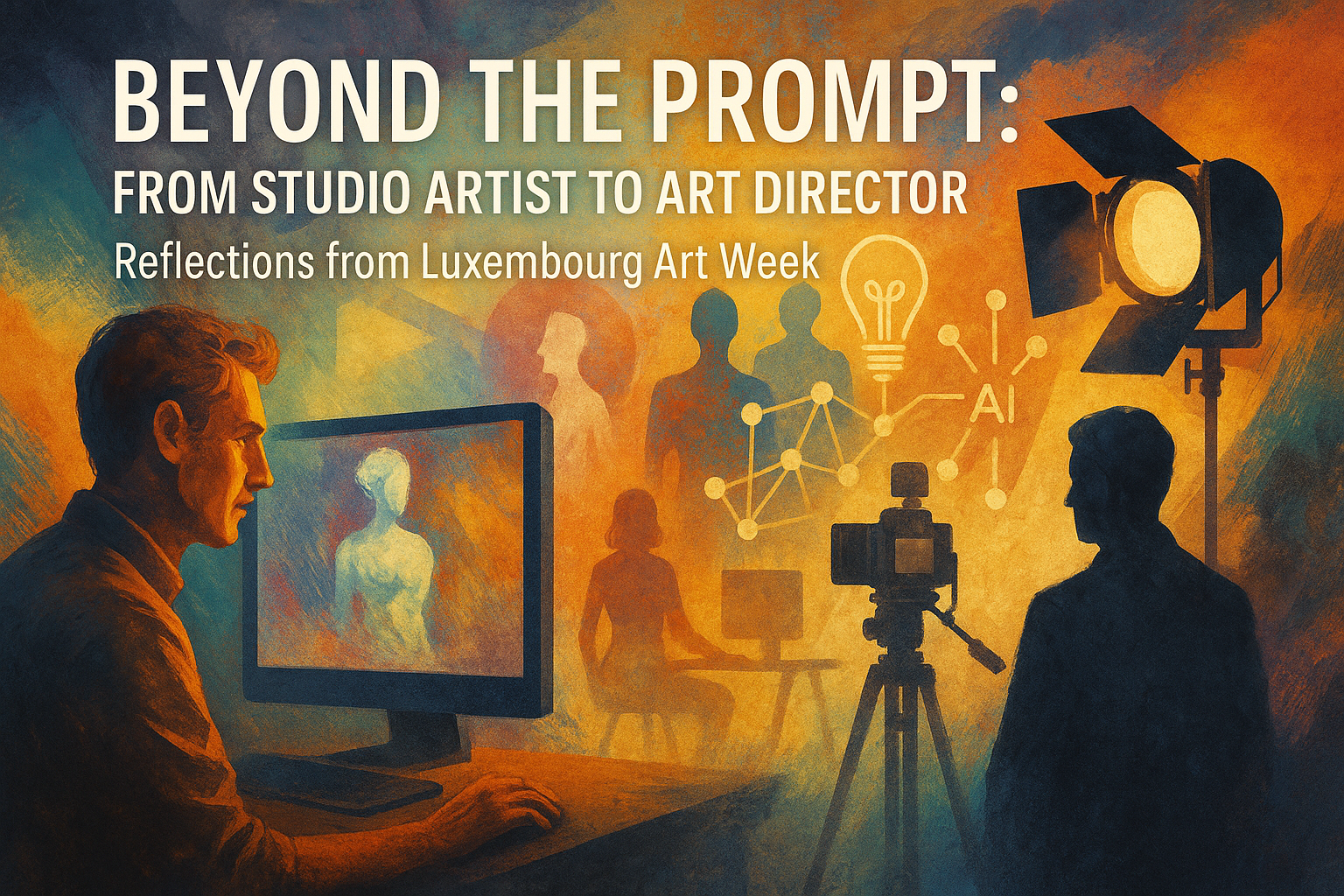
From lone photographer to AI-powered art director – step into my hybrid studio and see how the creative process is changing.
During a recent talk on AI and art organised by the Luxembourg Association for Art Galleries and Practitioners (LAFA) at Luxembourg Art Week, I was asked two very simple, yet fundamental questions:
How do you integrate AI into your creative process?
And how do you see your role as an artist in all of this?
These questions come up often whenever AI and art are mentioned together. So I decided to turn my answer into a blog post and share a bit more of what happens behind the scenes in my work.
I’m Benoît Theunissen, a multimedia visual artist, and my main medium is photography. Over the last few years, I’ve started to deeply integrate AI into my creative process, not as a shortcut, but as a new set of brushes, actors and collaborators.
Photography is still my anchor point, but around it I’ve been building an ecosystem of digital tools: some generate images, others create music or sound design, others handle motion, video, or even 3D. I combine them the way you might combine lenses, lights, actors and a film crew. Each tool has its own role. My job is to orchestrate that ensemble.
Creating visual archetypes and symbols
First, I use AI to create visual archetypes and symbols.
I feed it my own images, my references, my thoughts, and from that I generate shapes, silhouettes, patterns that feel like they belong to my inner mythology. These archetypes become a sort of visual vocabulary that I can then rework, collage and distort in my photographic tableaux.
They are not generic AI aesthetics; they are fragments of a personal universe, distilled and reassembled. I treat them like raw material: I cut, layer, erase, and hybridise them with my photographs until they feel fully integrated into my visual language.
Personas: AI as “actors” in my images
I also use AI to create personas — characters that act almost like actors or models in my work.
They are not just “pretty faces”; they are roles, presences, energies. I imagine who they are, where they come from, what they carry emotionally, and then I use AI to give them a body, a face, a posture.
Once they exist visually, I re-stage them through my photography, mixing real images, AI-generated material and physical interventions. Sometimes they appear almost human, sometimes clearly hybrid or surreal. In all cases, they are there to hold a certain emotion or narrative tension inside the image.
Sound, music and atmospheres
Beyond the image itself, I’m also exploring sound creation with AI: music and sound design.
I experiment with atmospheres that resonate with my visuals — sometimes abstract, sometimes more melodic. AI tools allow me to sketch ideas very quickly, to generate textures and moods I might not have found on my own. But I don’t stop there: I refine, edit and recompose, cutting and layering sounds the way I do with images.
The goal is for the sound to feel like an extension of the image, not an illustration. I want the viewer to feel they are entering a small, self-contained universe where sight and hearing are entangled.
Motion design and video: towards multisensory tableaux
The same goes for motion design and video animation.
AI helps me generate movements, transitions and visual textures that I wouldn’t have imagined on my own. Flows of light, slight distortions, shifts in perspective — all of these can be suggested by the tools, then curated and sculpted by me, frame by frame.
More and more, my work exists as moving, multisensory tableaux rather than static photographs. AI, in this context, is not replacing my photography; it’s expanding what a photographic work can become.
A concrete example: “(1)consciousness”
All of this is what I’m currently exploring in my exhibition (1)consciousness, taking place at Galerie Subtile in Belair.
The exhibition is a laboratory for this dialogue between my photographic practice and AI. Archetypes, personas, soundscapes and motion pieces coexist in the same space. The aim is not to demonstrate what AI can do, but to show how these tools can be woven into a coherent artistic universe, guided by a human vision.
My process doesn’t start with a prompt
At the Luxembourg Art Week talk, someone asked me if I simply prompt the machine, let it create, and then filter the results.
Of course I prompt — but it’s not the beginning of the process.
In terms of process, I don’t start with a prompt, I start with an idea. There is always an intuition, a question, a little obsession that kicks things off. I sketch, I write, I gather references, I think about the mood and the symbols. Only then do I go to the machine.
I really like the sentence, “An idea without execution is just a wish.” For me, AI is part of that execution: it’s one of the ways I turn the original idea into something concrete.
When I prompt, it’s never “magic” and it’s definitely not the whole process. It’s one step in a longer chain. I generate a lot, then I filter, I curate, I edit. I decide what fits, what doesn’t, what pushes the narrative forward. I mix those AI outputs with my own photographs, my own staging and my own choices.
The artwork is always a dialogue between my vision and what the tools offer.
From artist alone in the studio to art director
Because of this, I don’t see myself only as an artist alone in my studio anymore.
So instead of remaining an artist alone in my studio, I’ve almost become an art director of a larger, hybrid project. I’m no longer only the person who presses the shutter or edits the final image. I’m also:
the one who imagines and manages a full art project, almost like a project manager
the one who coordinates “AI teams”: virtual specialists for sound, motion design, character creation, sometimes even virtual actor direction.
With AI, you don’t go faster. It’s a myth. But, as an artist, you go further and deeper. It’s a boost of creativity, it’s a creativity multiplier.
The scope of what I can create has expanded enormously. But with that expansion, the creative process has also become more demanding. In this position of a project manager–art director, I need to develop and master many more skills than just my core photographic practice.
I have to understand storytelling, sound, animation, basic coding sometimes, and of course the logic and limits of AI systems themselves. I’m constantly pushed to go beyond my initial comfort zone.
Will AI replace artists?
To conclude, I don’t believe that AI will replace artists.
At the same time, I don’t think it will make our lives easier. Quite the opposite: it raises the bar. It asks us to be more curious, more critical, more intentional.
For me, AI is not a threat to my identity as an artist, but it does force me to evolve. It’s more demanding, yes — but it also allows me to go much further and much deeper in my work. It obliges me to constantly learn new techniques and tools, to refine my vision, and to take full responsibility for the choices I make.
In short, AI doesn’t do the art for me.
It expands the playground, and I’m the one who has to decide what to build inside it. Control over each part of the creative process is paramount.