

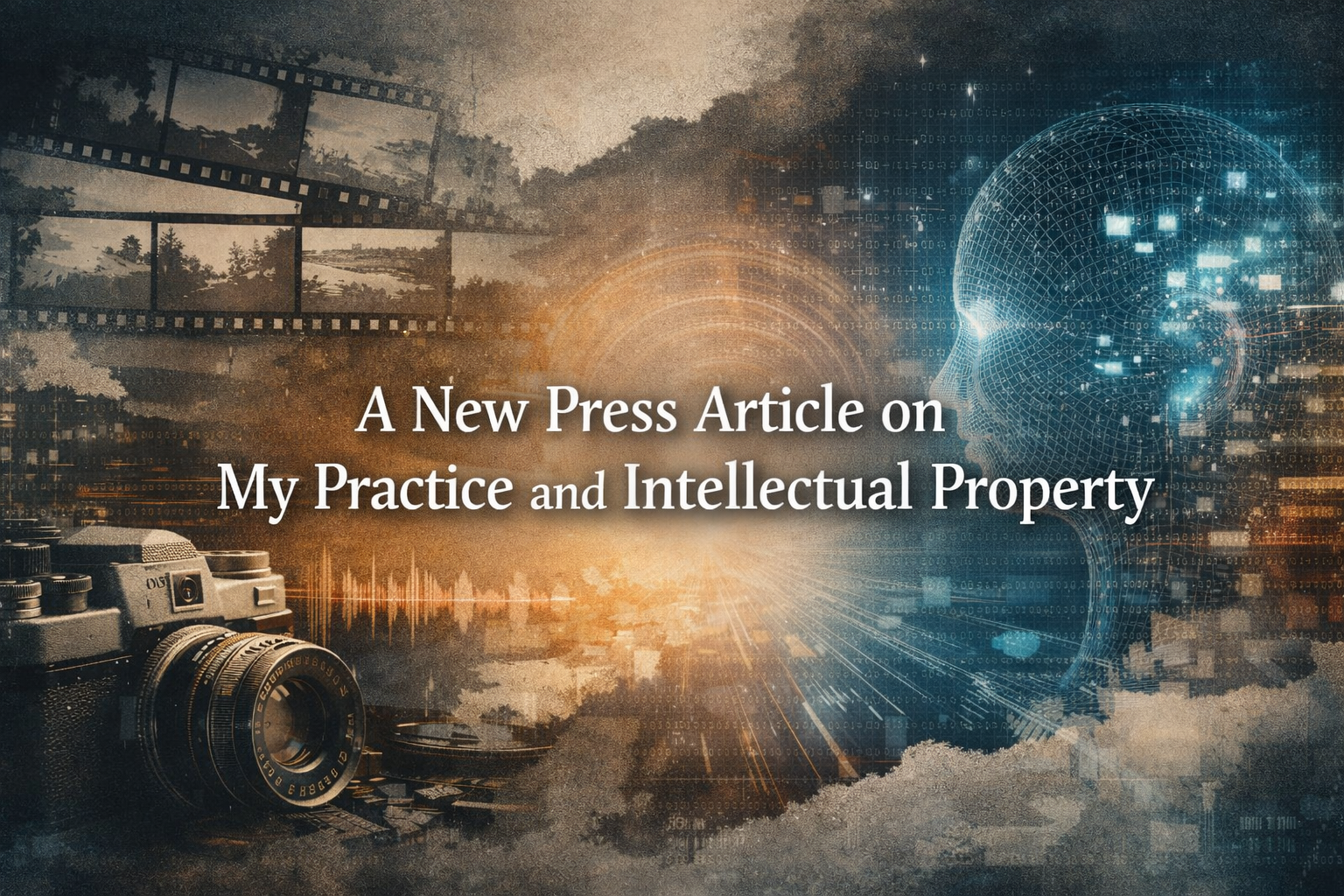
A New Press Article on My Practice and Intellectual Property
tools, generative technologies and hybrid workflows reshape how artists work and share their creations, the question of how authorship is defined, protected and communicated becomes increasingly urgent.
I am therefore delighted to share the publication of a new case study about my practice on Creatives Unite — a European platform dedicated to supporting the cultural and creative sectors through insights, resources and stories from across Europe.
The article is titled « From Analogue Roots to Digital Rights: Benoît Theunissen’s IP Journey » and was produced in collaboration with the Intellectual Property Institute Luxembourg (IPIL). It explores how my work, situated between analogue photography, digital creation and AI-assisted processes, confronts the challenges and opportunities of authorship in the contemporary creative landscape.
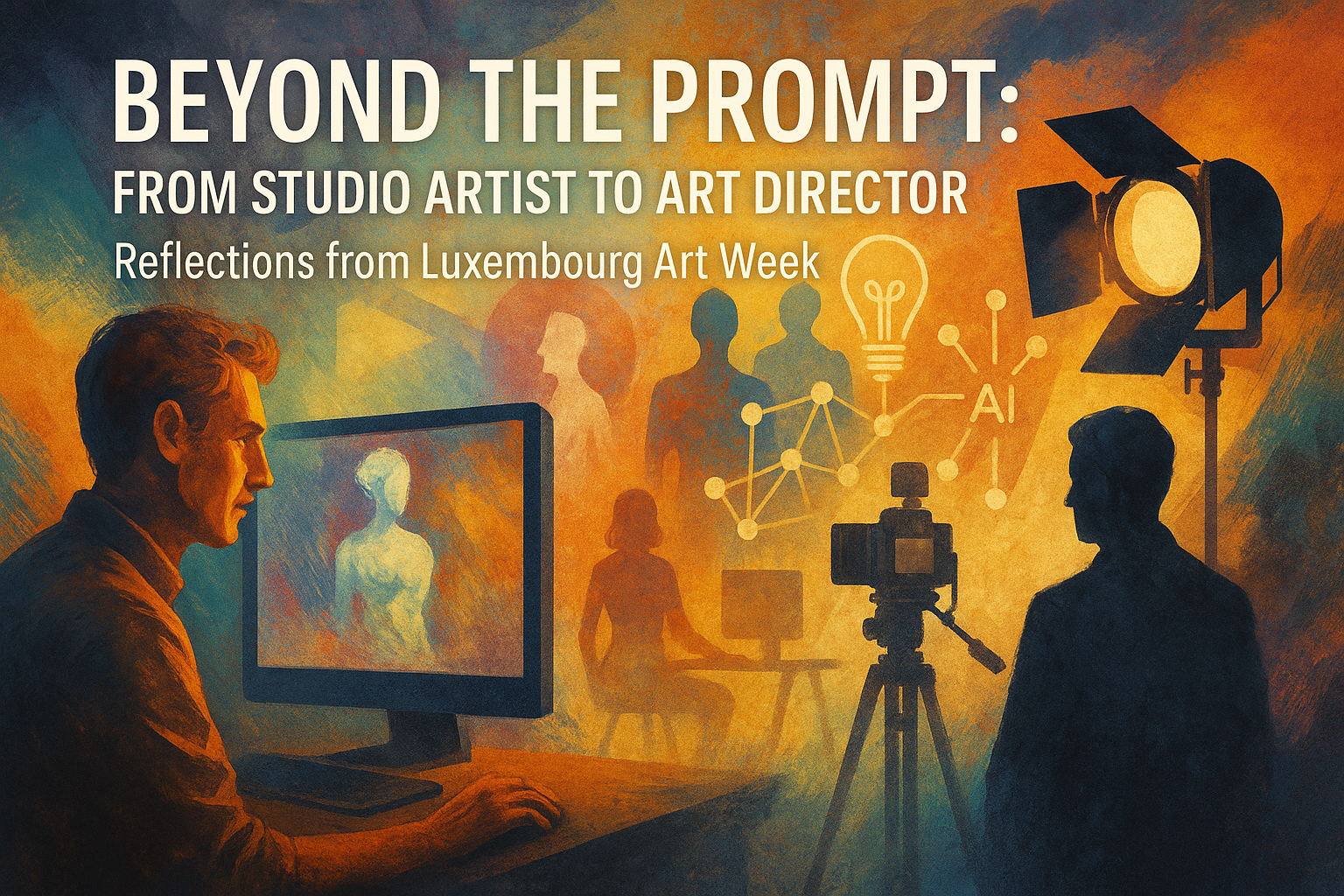
Beyond the Prompt: From Studio Artist to Art Director
During a recent talk on AI and art at Luxembourg Art Week, I was asked two very simple, yet fundamental questions:
How do you integrate AI into your creative process?
And how do you see your role as an artist in all of this?
These questions come up often whenever AI and art are mentioned together. So I decided to turn my answer into a blog post and share a bit more of what happens behind the scenes in my work.
I’m Benoît Theunissen, a multimedia visual artist, and my main medium is photography. Over the last few years, I’ve started to deeply integrate AI into my creative process, not as a shortcut, but as a new set of brushes, actors and collaborators.
Photography is still my anchor point, but around it I’ve been building an ecosystem of digital tools: some generate images, others create music or sound design, others handle motion, video, or even 3D. I combine them the way you might combine lenses, lights, actors and a film crew. Each tool has its own role. My job is to orchestrate that ensemble. as an art director.
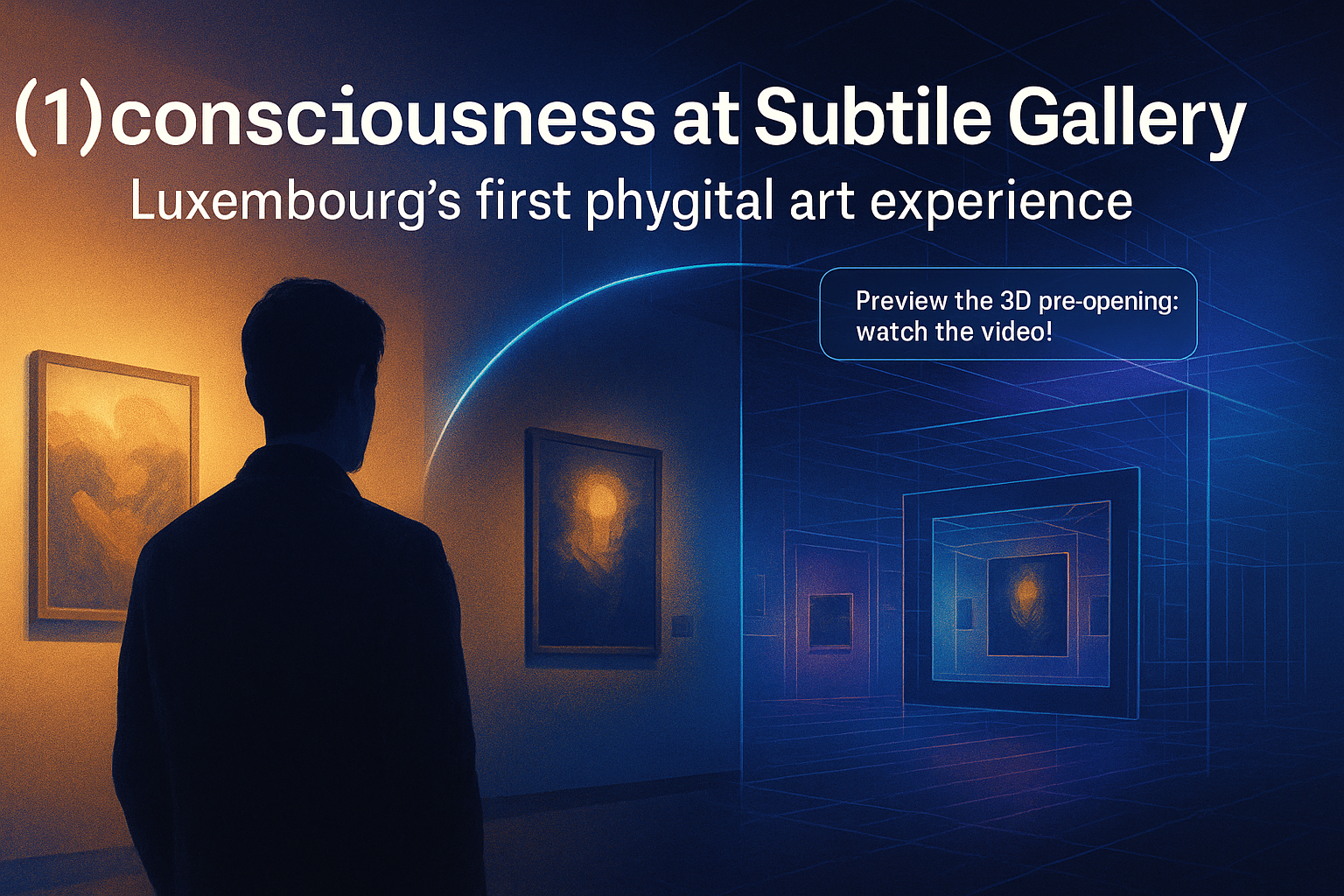
(1)consciousness at Subtile Gallery: Luxembourg’s first phygital art experience
In October 2025, I presented my exhibition (1)consciousness at Subtile Gallery in Luxembourg — and we used the occasion to do something that hadn’t been done in Luxembourg before: launch a truly phygital exhibition, experienced first in a live 3D space and then in the gallery on the same day. This wasn’t a simple online teaser, but a real-time guided visit in a virtual twin of the show, followed by the physical vernissage.
👉 The exhibition is accessible on site until 30 November 2025.
One hour before the opening at Subtile, we welcomed guests into a 3D virtual gallery. I introduced the different series, explained the techniques I work with (Intentional Camera Movement - ICM -, composite photography, glitch art, AI-assisted pieces, digital painting…), and answered questions live — including from people who weren’t in Luxembourg.

Am I still a photographer?
After 20+ years, the camera is now the starting point of my work, not the finish. Generative AI and digital technologies have reshaped my process — photographs serve as raw material for a broader dialogue between image, data and imagination. Some will say photographer, others digital artist; I operate in the space between, where the work speaks for itself.
The artist at the threshold of change
Recently, I took part in a podcast about art and technology. As a visual and digital artist, I see digital technologies not as a threat, but as a multiplier of creativity. They amplify intuition, open new doors, and transform the way an artist inhabits his gesture.
Since the arrival of generative artificial intelligence, my own process has changed profoundly. Where photography once marked the end of my creative path, it has now become only the starting point.
And sometimes, I find myself wondering: am I still a photographer?

Podcast 🎙️ — IA et art: comment j’intègre le numérique à ma pratique
Pour les francophones d’entre vous qui me suivent, j’ai le plaisir et l’honneur de vous annoncer que j’ai participé à un podcast qui traite de l’IA et de l’art, mais aussi de l’apport des technologies numériques dans ma pratique artistique.
Il y a quelques mois, je faisais la connaissance de Nathalie Mandonnet, une voisine de bureau, autour de la machine à café. Je découvre alors qu’elle est coach certifiée et autrice du blog evoluxis.com. Elle y traite du coaching professionnel orienté carrière, où elle publie des contenus sur la recherche d’emploi, le bien-être au travail, la reconversion professionnelle, et bien d’autres sujets. Elle ambitionnait d’y lancer un podcast sur ces thèmes.
Un angle à contre-pied
Bien consciente des multiples enjeux de transformation des ressources humaines dans les environnements professionnels, Nathalie s’est naturellement penchée sur le thème très actuel des intelligences artificielles génératives. Mais plutôt que de traiter le sujet de son podcast sous un angle RH, emploi ou process traditionnel — comme il en existe désormais beaucoup depuis trois ans — elle a cherché un angle plus original: comprendre comment les artistes vivent la transition vers une société où l’IA prend chaque jour plus de place. Et ça tombait bien, elle avait justement un artiste visuel numérique devant elle en prenant son café…
À l’avant-garde des technologies
On a parfois l’image galvaudée d’un artiste qui reste seul dans son studio, isolé du monde extérieur. Soyons honnêtes: cela arrive, mais pas systématiquement. Un artiste reste connecté au marché de l’art — une industrie à part entière — et à ses fonctionnements économiques. Et un artiste numérique se doit de faire une veille constante des évolutions technologiques qui, tantôt, enrichissent ses techniques, tantôt les mettent en péril.

Selling digital art in the real world: tax, trust and tangible value
As digital art continues to evolve, so do the ways we display, sell, and collect it. But behind the screen lies a complex web of questions — about value, legality, taxation, and material presence. In this post, I share my perspective as a digital artist navigating the practical and philosophical challenges of turning intangible works into lasting experiences.
In my previous blog post, I explored different ways of distributing, exhibiting and collecting digital art, with a particular focus on the increasingly vital role of galleries. The scenography of digital works is a key part of this equation: how can we present digital pieces in a physical space in a way that enhances their impact? And as an artist, how can I step into the shoes of a collector seeking to integrate these works into their daily environment?
My goal remains the same: to show that digital art can be seamlessly integrated into everyday life, without requiring overly complex or expensive technical setups. The challenge is to strike a fine balance between user experience, display quality, and economic accessibility.
But presenting digital works in a clear and engaging way is not the end of the road. One must also be able to demonstrate their value. A fully virtual, dematerialised piece inevitably raises questions about its artistic and commercial legitimacy.

Digital art is still looking for its place — and so are we
As I prepare Terra Numerica, my upcoming exhibition in Luxembourg this November, I find myself facing both a concrete and symbolic challenge:
how can digital art fully exist in a physical space?
This exhibition is designed as a sensory exploration of digital realms, but it also, almost inevitably, raises deeper questions: how is digital art perceived, circulated… and consumed? And perhaps more urgently: how can it be inhabited?
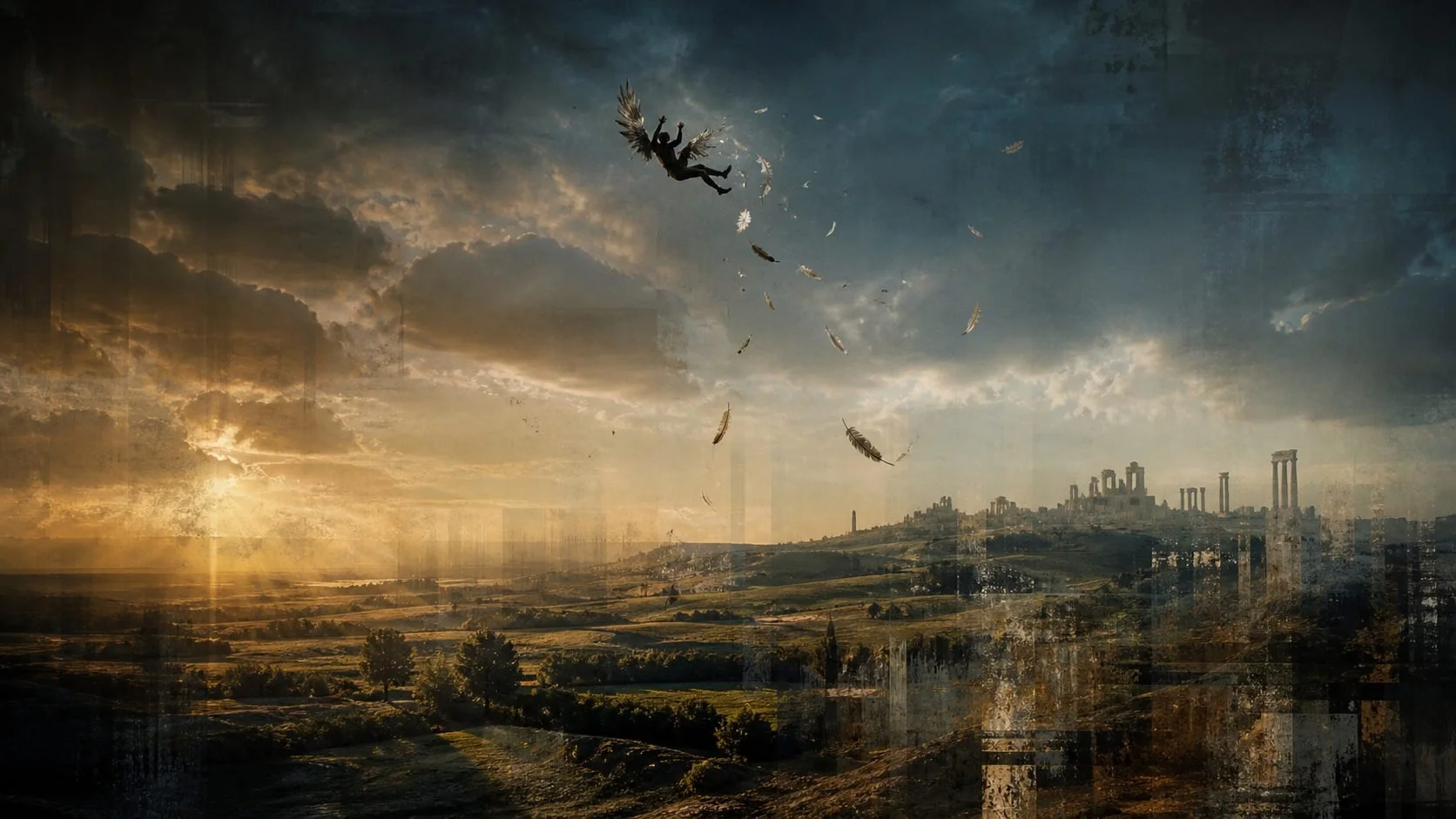
Icare réhabilité, ou comment une note oubliée est devenue ma collection signature
J'ai senti il y a quelques mois qu'il était temps de créer une collection signature. Une œuvre d'ensemble qui synthétise les techniques que j'ai développées au fil de mes collections récentes — matte painting, photographie composite, IA générative, mouvement intentionnel de l'appareil. Mettre tout cela au service de quelque chose de plus profond que l'exercice technique.
Restait à savoir quoi.
Pendant deux mois, je suis resté devant la page blanche. Quelques intuitions flottaient, rien de solide. J'avais oublié quelque chose qui me semble pourtant évident quand je le formule maintenant : le pouvoir des mots. Non pas leur pouvoir de persuader, mais leur capacité à raviver les braises de la création.
Ce qui m'a réveillé est venu d'un endroit que je n'attendais pas. En fouillant dans mes archives d'écriture, je suis tombé sur un texte que j'avais rédigé un an plus tôt, après une promenade dans la campagne du Brabant wallon. J'étais rentré chez ma famille, et le paysage m'avait frappé — collines douces, champs sans fin, ciel chargé. C'était l'univers visuel des peintres flamands de la Renaissance, en particulier Bruegel l'Ancien.
Entretien dans Artist Closeup
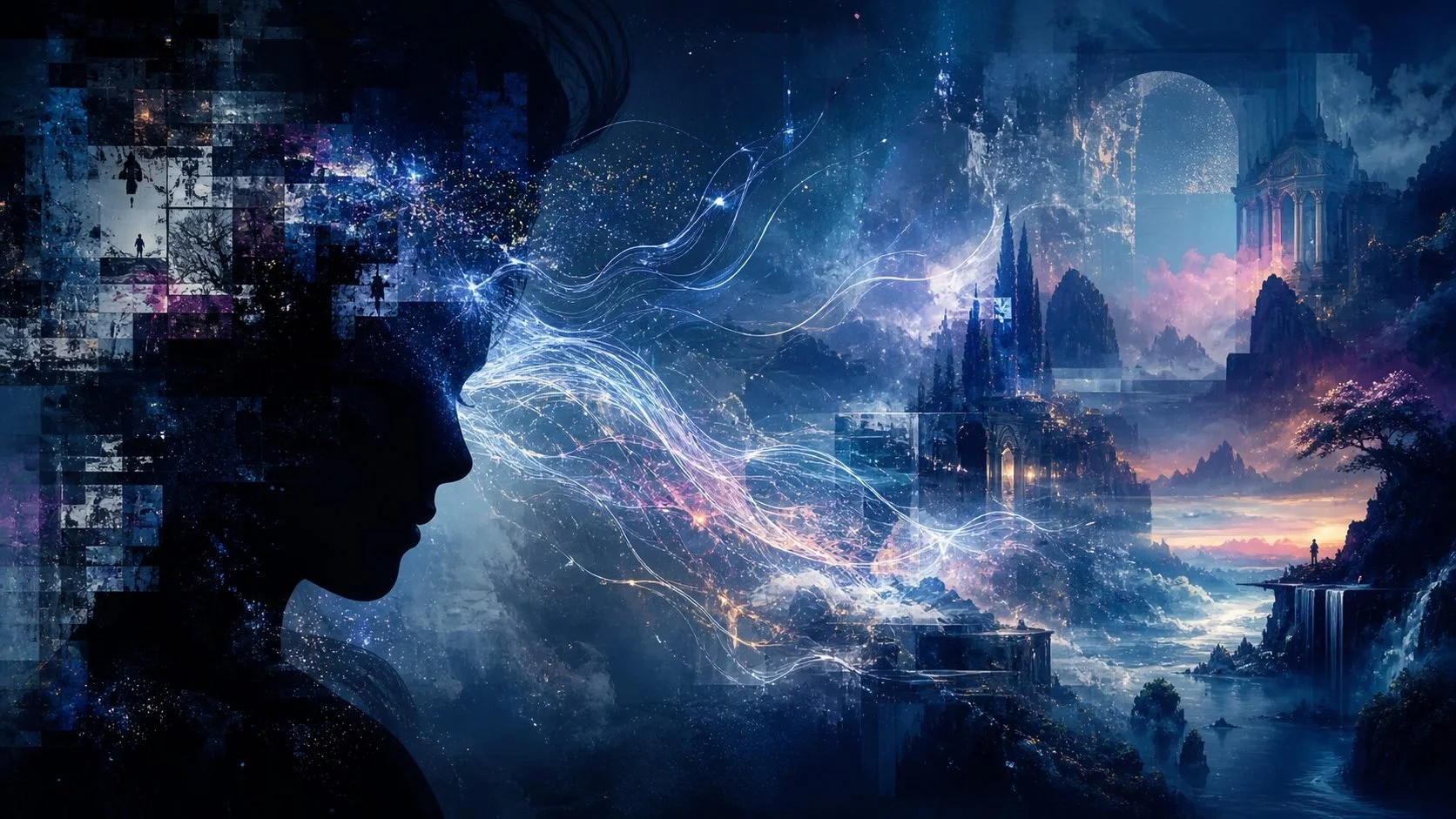
J'ai accordé récemment une interview à Artist Closeup, dans laquelle j'ai pris le temps de revenir sur quelques questions qui traversent mon travail depuis longtemps : le passage de la photographie documentaire à l'abstraction onirique, le rôle des archétypes jungiens dans la composition de mes images, l'esthétique du glitch comme manière de rendre visible la saturation perceptive, et la place du métaverse dans une pratique qui interroge le réel.
L'exercice de l'entretien est intéressant — il oblige à dire à voix haute des choses qu'on porte sans toujours les avoir formulées. Quelques formulations sont sorties que je n'aurais probablement pas trouvées en écrivant seul.
L'une d'elles, que je voudrais reprendre ici :
Je ne cherche pas à montrer à quoi ressemblent les choses. Je cherche ce qu'elles produisent, sous la surface.
C'est une phrase qui a l'air simple mais qui me suit depuis l'entretien. Elle dit quelque chose de précis sur ce que je tente de faire avec la photographie : non pas reproduire l'apparence, mais saisir ce que l'apparence active dans la perception. Une émotion, un déjà-vu, une dissonance, un trouble. C'est cela qui m'intéresse, plus que la fidélité au visible.
Urban Mirage commenté par ANASAEA
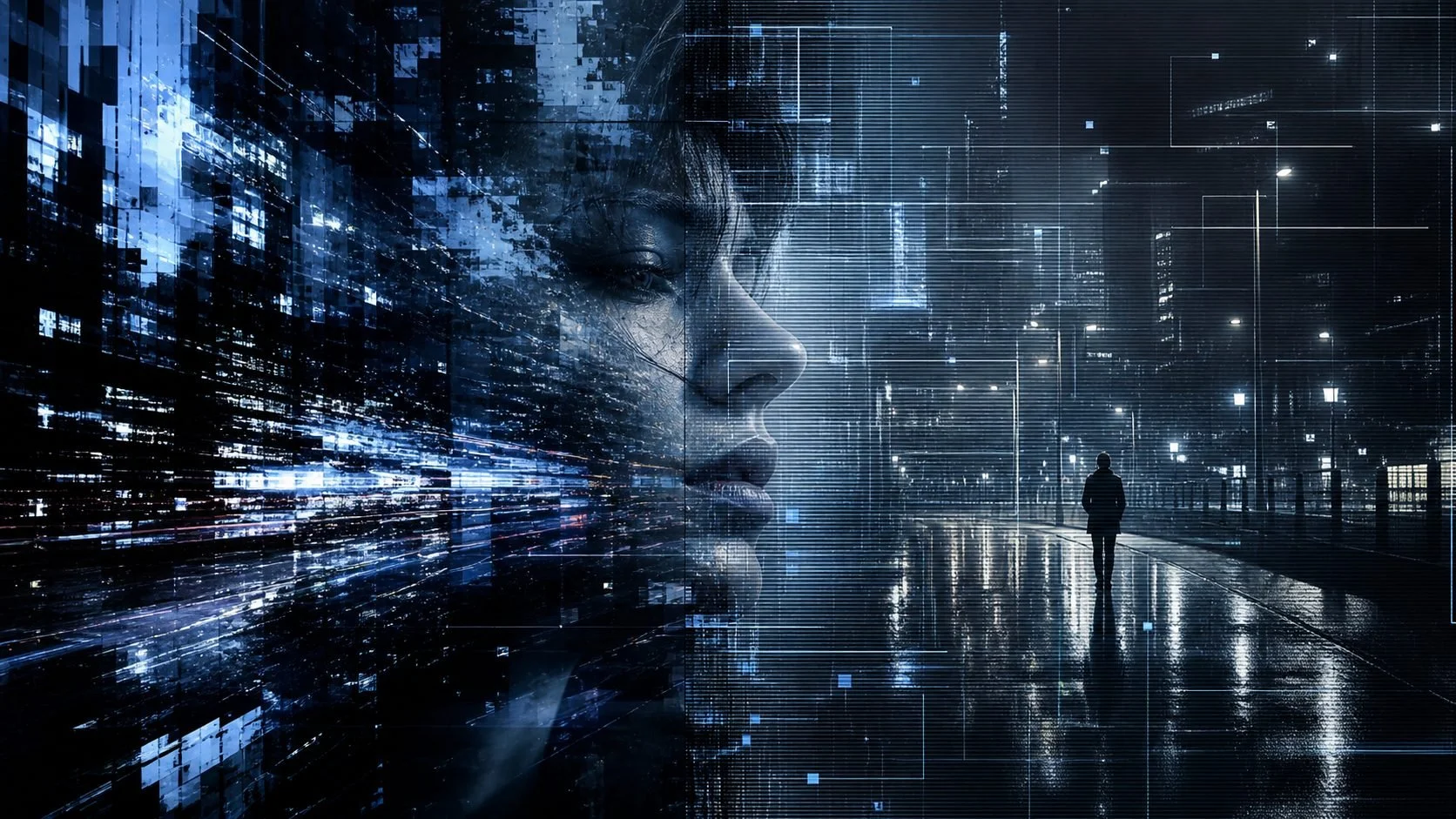
ANASAEA, plateforme dédiée à l'art dans le métaverse dont je suis ambassadeur, a produit un commentaire critique audio de mon œuvre Urban Mirage, une pièce de ma collection City Stream. Je trouve l'exercice intéressant — moins pour ce qu'il dit de l'œuvre que pour ce qu'il révèle d'un déplacement plus large. Une critique d'art produite par une institution qui n'existe que dans le métaverse, sur une œuvre qui questionne précisément la perception du réel à l'ère numérique. Il y a là une circularité qui mérite qu'on s'y arrête. Urban Mirage est née à Manhattan, mais Manhattan n'en est pas vraiment le sujet. Quand on marche dans le Financial District ou à Midtown aux heures pleines, on n'est pas un sujet qui regarde un objet. On est dans un flux. Le visuel, le sonore, l'humain, les signaux numériques qui circulent dans nos poches et au-dessus de nos têtes — tout cela compose une matière dense dans laquelle le regard se perd. C'est cette saturation que j'ai cherché à rendre visible.