

Digital art is still looking for its place — and so are we

As I prepare Terra Numerica, my upcoming exhibition in Luxembourg this November, I find myself facing both a concrete and symbolic challenge: how can digital art fully exist in a physical space?
This exhibition is designed as a sensory exploration of digital realms, but it also, almost inevitably, raises deeper questions: how is digital art perceived, circulated… and consumed? And perhaps more urgently: how can it be inhabited?
🧊 When art loses its body
Over the past thirty years, digital technologies have radically expanded what artists can do:
composite photography, algorithmic painting, generative art, artificial intelligence, virtual reality, interactive installations…
The creative field has exploded beyond traditional boundaries.
But as the artwork dematerialises, the viewer’s experience becomes more fragile.
A file, a code, a projected light — how do we collect it? Exhibit it? Truly feel it?
Can art without substance still move us?
Can art without a frame still hold its place?
The question may sound provocative, but it reflects a deeper truth: digital creation disrupts our sensory habits and our expectations of presence.
Art is not merely an idea or a message — it is also a physical, emotional encounter.
And without that exchange with the viewer’s body and senses, a work remains latent, suspended.
🛠 The logistical challenge of immateriality
This paradox is something I face daily as a digital artist — and all the more so while preparing Terra Numerica.
To present a digital work in a gallery means giving it form, even if temporarily.
It often involves:
high-definition screens,
projection systems and immersive sound,
virtual reality headsets,
custom-built equipment and supports.
Each piece demands a specific setup.
And presenting an entire collection becomes quickly logistically complex, financially demanding, and technically precise.
It’s not the technology that’s lacking — it’s already embedded in our everyday lives.
What’s missing is a sensitive, intentional way of staging it so that it fosters presence, emotion, and engagement.
🏛 The irreplaceable role of galleries
As a digital artist, my wish is simple:
to see my work leave the frictionless void of the screen and enter real, lived spaces.
Into homes, workplaces, bodies, and glances.
And for this to happen, galleries are essential.
Not just as white cubes or showrooms, but as cultural mediators between digital creation and its adoption by collectors and the public.
Some voices claim that digital distribution — via online platforms, marketplaces or NFTs — will eventually make galleries obsolete.
I believe quite the opposite.
🔗 NFTs and blockchain: a fragile promise
NFTs and blockchain have sought to address some core concerns — authenticity, traceability, uniqueness — but they remain complex, unstable, and largely inaccessible to a broader audience.
They require technical expertise, a working knowledge of cryptocurrencies, and immersion in an ecosystem that is still niche, often speculative, and not always artistically led.
We are still far from the seamless fantasy of studio-to-collector distribution.
🤝 A new kind of partnership
Galleries have a critical role to play here —
not just by exhibiting digital artists, but by becoming active partners in rethinking how digital art is received, lived with, and shared.
That means:
understanding the digital medium’s specific challenges: format, reproducibility, fragility,
building hybrid exhibitions that blend innovation with emotional presence,
guiding collectors through new ways of experiencing artworks — at home, at work, on the move.
It’s not just about making the work accessible.
It’s about making its reception meaningful.
🌱 Emerging solutions
Some promising technologies are already being developed:
high-end digital frames,
streaming platforms for curated art collections,
display systems integrated into domestic or professional settings.
But these remain expensive, limited in supply, and vulnerable to geopolitical or supply chain disruptions — especially when it comes to electronics, resins, and specialist materials.
Supporting these initiatives is vital.
But waiting for a perfect infrastructure before shifting our habits would be a mistake.
📲 We already have what we need
The truth is, we’re already surrounded by screens.
Smartphones, tablets, laptops, 4K televisions, professional monitors —
each one a potential window for digital art.
The real barrier isn’t technical.
It’s cultural.
It’s psychological.
It’s about intention.
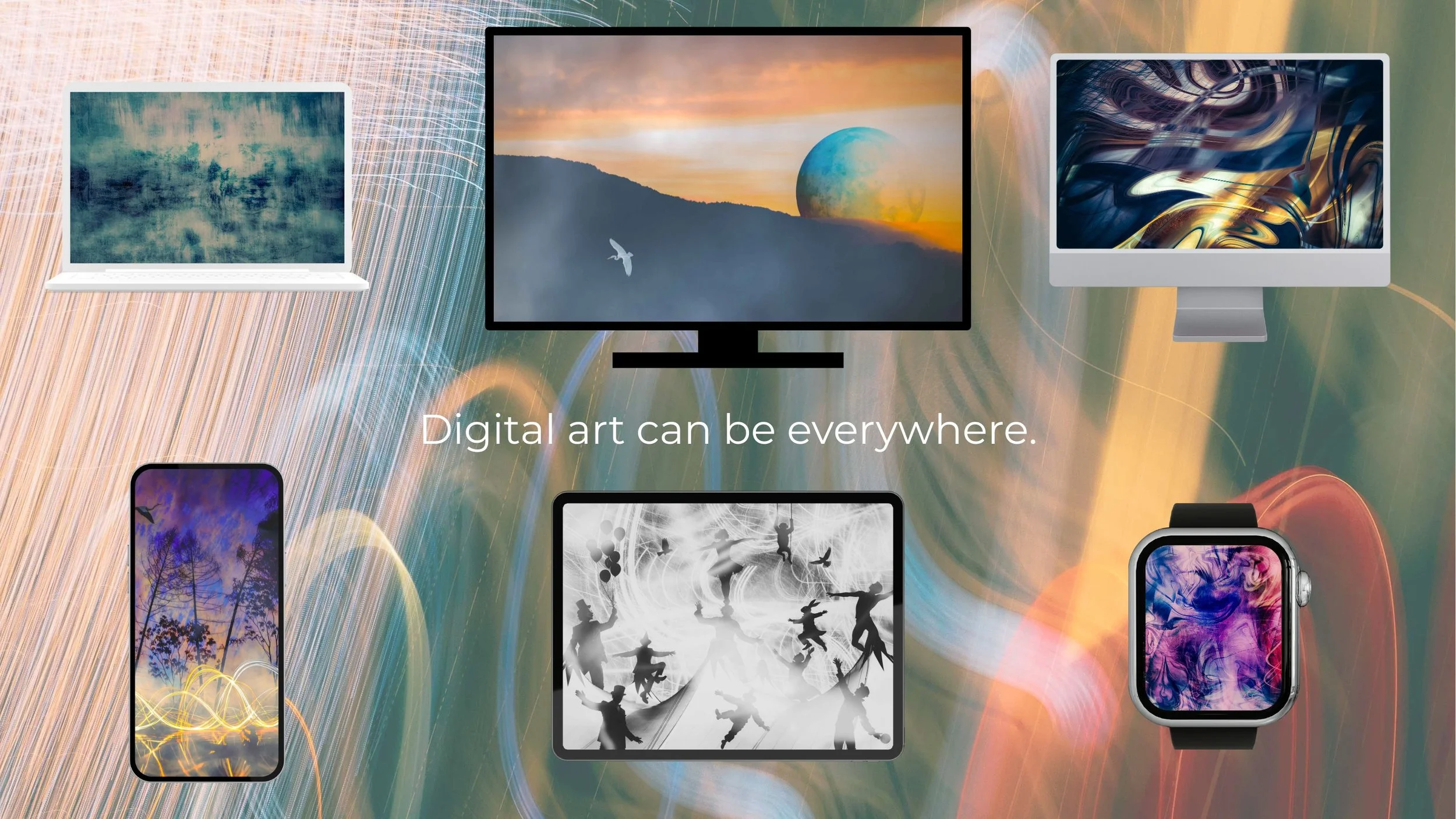
Every screen of our daily live can host digital art works.
💡 Digital art is not content
Scrolling past artworks on Instagram, liking a post, saving an image — these are not acts of artistic engagement.
To truly collect digital art is to:
choose a piece,
purchase it in a limited edition,
install it in a dedicated space,
give it attention — time, presence, and care.
It’s a gesture.
A form of responsibility.
An encounter.
Digital art is not a gimmick.
It’s not noise.
It’s a form.
It’s a language.
And perhaps tomorrow, a new way of living with images.
📬 What comes next
Terra Numerica opens this November at Galerie Subtile, Luxembourg.
Alongside the exhibition, I’ll be using this space to share reflections, images, and field notes from the shifting frontiers of digital art.